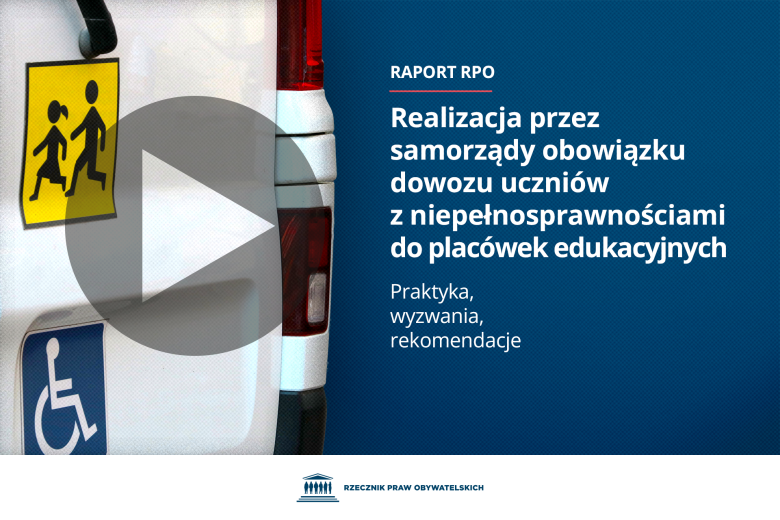

Report "Implementation of transport for students with disabilities to educational institutions by local government units."
Date:
For many years, the Commissioner for Human Rights has been actively involved in the issue of transporting students with disabilities to educational institutions. In response to ongoing reports of systemic issues regarding this matter, in 2024, the Commissioner conducted a social study titled: "Implementation of transport for students with disabilities to educational institutions by local government units." Its objective was to illustrate how education law regulations are applied in practice. Specifically, the study aimed to determine whether transport fulfills its intended purpose: facilitating access to education for students with disabilities.
The report reveals, among other things, that:
- Rising Costs: Between 2020 and 2024, there was a significant increase in transport costs for students with disabilities. The average cost per student rose from PLN 8,281 to PLN 13,280, and reimbursement costs for parents quadrupled.
- Systemic Barriers: The main obstacles in fulfilling this duty include insufficient funding, high prices for transport services, an inadequate number of adapted vehicles, and difficulties in optimizing transport routes.
- Staff Qualifications: The study revealed that only a few municipalities organize training for drivers, and caregivers often lack proper qualifications, usually limited only to a first aid course.
- Administrative Hurdles: Administrative procedures for applying for transport or cost reimbursement are often unclear and time-consuming. Information on how to submit applications can be difficult to access, especially for parents who are less tech-savvy.
The "Nearest School" Conflict: There are problems with the uniform interpretation of "the nearest school." For municipalities, the deciding factor is often the cost of transport and thus physical distance. For parents, the key factor is how a given school meets their child's specific needs. This often leads to the refusal of cost reimbursements for transport to facilities better suited for the student.
These issues significantly impact the lives of families with children with disabilities; long hours spent traveling negatively affect the children's education and social integration. The report emphasizes the need to improve funding, simplify administrative procedures, and raise the qualifications of personnel involved in the transport process to ensure real access to education for children with disabilities.
https://bip.brpo.gov.pl/pl/content/raport-rpo-dowoz-uczniow-niepelnosprawnosc-samorzady